Showing posts with label north delhi. Show all posts

Monday, 20 February 2012

The One and Only Rahim!


Rahiman dhaga prem ka mat todo chatkay
Tute se phir na jude, jo jude to gaanth pad jaaye

Don't snap the thread of love, O Rahim,
Once broken, it cannot be mended. If mended, there will always be a knot

I came across this as a boy of twelve, in a remote village of Himachal. For good measure, our Hindi teacher conveniently displaced the word 'love' with 'friendship'. Fair enough, twelve year olds are perhaps not supposed to understand love, of any kind whatsoever. In the same courses, we had couplets by Kabir Das. Kabir was a 16th century 'low-caste' weaver who transcended his background, education (or the lack of it) and recited some of the most beautiful things ever in Khadi Boli and Hindi. Most of his work was documented much later through oral tradition. For some reason, the image of a poor man sitting in his hut by the Ganga in Banaras weaving away and reciting nuggets of wisdom stuck in my head and I associated it with everyone writing couplets in Hindi, Urdu or Khadi Boli. That another well known poet Raidas (also known as Ravidas) was Kabir’s contemporary, a poor cobbler, and very wise did not help matters.

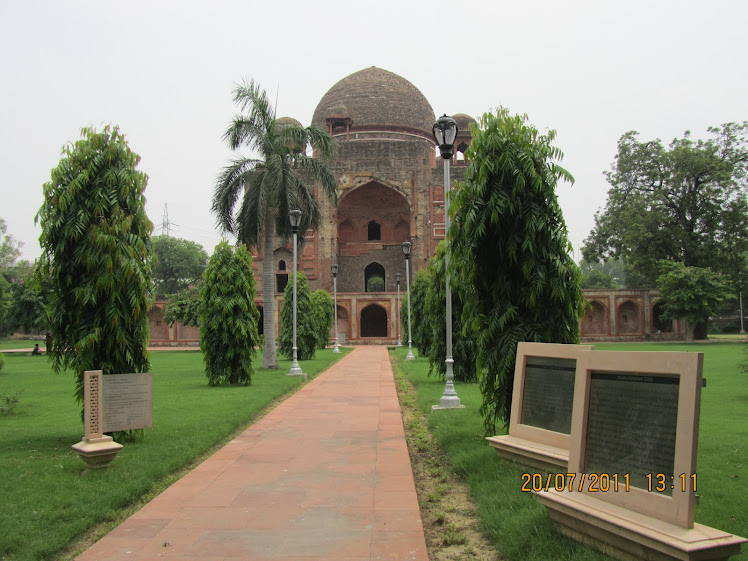
From there on, I imagined Rahim to be an impoverished mendicant dressed in tattered clothes, wandering through the world. I never associated a profession with him but he could have been a potter or an iron-smith. He would slave away for subsistence and, in his daily struggles, manage to see profound wisdom that escaped the mortals around him. Imagine my surprise then, when I learned that Rahim was a noble in Akbar's court, a wealthy governor, one of the navratnas, an accomplished warrior among much else. He was also an accomplished writer and translator, he translated Babar's autobiography from Chagatai to Persian.  And he has a tomb in Delhi, right next to the tombs of Hazrat Nizamuddin Auliya and Humanyun. He is clearly keeping exalted company even in death. His resting place has been ravaged by time and the makers of Safdarjung's tomb, but that does not take anything away from its impressive size. With a little imagination, you can still see the delicate carvings on the walls, the ornate jharokha work on some of the small windows, and the grandeur of the grounds in the centuries past. Feeding off of the ghost story told to me by a security guard in Masjid Moth, I even imagined Rahim's ghost procession joining Humanyun's to seek Nizamuddin's blessings.

What has continued to hound me though is how could a blue blooded man, a noble and a wealthy man have the time, the depth, and the perspective to be such a profound thinker. Not taking anything away from Kabir (who I already called The Winner), it was probably easier for a Kabir to brood over life, for he did not have many other cares, no provinces to govern, no wars to fight and win, no autobiographies to translate and no emperor to please. For Rahim to have achieved what he did in literature is truly outstanding. It is perhaps fitting then that there are two Rahims in my mind and the two exist in different worlds. And lest I forget, when we met him in December, even Sam Miller was not aware that there was only one Rahim!

Bade badai na karen, bade na bole bol,
Rahiman heera kab kahe, lakh taka mera mol.

The truly great never boast about themselves or talk about their worth,
O Rahim, when does a diamond ever say it is worth a million.


Goodness! Forgot to mention, all photos above courtesy Wanderfool of A Date with Delhi.

Monday, 26 December 2011

Qudsiya Bagh

 In my last post about the wanderings on the ridge, I made a brief mention of Qudsiya Bagh and then promptly forgot about it. That was until this Sunday. Browsing the internet for something random, I came across a website of old Indian photos. It had a photograph of the Qudsia Bagh masjid from just after the mutiny (war of independence) of 1857. Taken in 1858 by Dr. John Murray from the Western side, it shows the collapsed or collapsing arches of a bridge on the right and the main building of the mosque, all holed and battered perhaps by the gunfire.
The Qudsiya Masjid in 1858
In some ways, the Qudsia Bagh of today stands in a very similar setting. First of all, it is, amazingly, still a bagh i.e. a garden. It still is an island of silence and serenity right next to the bus station. Unusual for such a setting, there are no amorous couples here. All we came across were the caretaker of the mosque and a couple of old ladies sitting under an old gate. The mosque is still alive, the domes in the exaggerated late Mughal style. The damage to the standing walls has been covered up with plaster but none of the collapsed walls have been rebuilt. The gate has ornate red sandstone carvings and decorations with floral patterns and vines.

Qudsia Bagh is not a place I would recommend a standalone visit to. However, if you are around the bus station with a few minutes to spare, do walk over. It is short, it is sweet and it is stunningly serene and detached. The mosque, the old gate, and one later structure (which looks like a mansion but we could make nothing further of) are the bonuses.

Qudsiya Masjid in July 2011
The gateway
Floral patterns on the arch

Friday, 28 October 2011

On the Ridge


In City of Djinns, William Dalrymple briefly mentions a bungalow that William Fraser built for himself on a hill. The mention is only about a sentence or two. Read carefully, it yields two things important enough to hold my attention any day. That it was built by William Fraser and that it was atop a hill. For the uninitiated, my love for William Fraser is documented here and that for the hills much more extensively at Trek Himachal. Obviously visiting the bungalow immediately became a personal quest. So, when one July morning a friend, Varsha, expressed a desire to see the Northern ridge, I had every reason to accept.

We got into the swanky Delhi Metro from Hauz Khas and got off at Kashmere Gate. After stopping briefly at Qudsiya Bagh and wandering around a city park we quibbled over which direction to take, (and sadly, I lost the argument) before we finally got into an auto for the Hindu Rao Hospital.

It was a surprisingly short auto ride. Towards the end it got really interesting, weaving through a couple of small lanes before eventually climbing up a steep hill. I had no idea such steep slopes existed in Delhi. Eventually, we were dropped off at the entrance of the Hindu Rao Hospital, and had no clue what to do. Dalrymple had said Fraser's bungalow had been converted to Hindu Rao Hospital, named after a Maratha merchant of that name, who had bought the bungalow after Fraser's death. An ASI book we were carrying said the same thing. We had assumed we would get off the auto and bingo, bang in front of us we would see a charming building from early Raj with fluted columns and colonnades. Instead, there was a 1980s, dilapidated, typical stinky hospital looking at us with sleepy, disinterested, eyes. Lost of purpose, we walked around a bend in the narrow road and spotted a police post. But Varsha refused to use her womanly charms to quiz a policeman for the whereabouts of the haveli so we moved a little further down the road trying to orient ourselves while sifting through the pages of the ASI book.

Just before we passed the last of the hospital grounds, we spotted another guarded gate. Just to prove a point I had been making (that I am a very charming man), I politely asked the guard on duty for a baoli in the area which the ASI book mentioned. People are more likely to know old, unused baolis than re-used havelis. After a bit of apprehension, he actually led us inside the gate. While I was basking in the afterglow of having proven my point, Varsha looked around and whooped at having possibly found Fraser's haveli. I am not sure why she got so excited. What stared us in the face was a sad, half mossy, stinking, unkempt building showing multiple failed attempts at renovation. We tried going inside but were blocked by a pile of broken chairs. Anyway the room stank like a public loo in Kashmere Gate. I lost all my enthusiasm.. I have been to many a ruin covered in shit but this building was supposed to be in use. You could see name plates outside doors and yet it was stinking of pee. It was unbearable!

Walking a little further down the road, the baoli was not much different either. Parts of the walls had caved in and it was fenced off. Tall grass grew around it and, moss settled into the empty places left by fallen stones. ASI had fenced it off physically and fenced it off their minds as well. A little further after the baoli, was Pir Ghaib and it was a completely different story. It is a curious structure. I didn’t know what to make of it. Actually, no one does. One legend goes that a sufi resided here and one day just disappeared. Disappear is ghaib in urdu, hence the name. Who the Sufi was, when he lived, how and why he disappeared, no one seems to know. There is no mihrab anywhere to indicate a place of worship. The couple of graves inside are not conventionally oriented. The ceiling has a couple of openings which seem to be part of an astronomical observatory. Then there is the theory that this could have been a part of Kushk-i-shikar, Feroz Shah Tughlaq's hunting lodge on the ridge. There are very steep staircases with very narrow stairs on the first floor leading to the rooftop. From there, you can peer down through the holes to the ground floor and also look around many parts of North Delhi. It is two floors high on a high hill in Delhi and in a green area with very little haze. This is about the best view you can get in the city.
The curious Pir Ghaib, of the Pir who disappeared curiously

After Pir Ghaib, we went to the Asokan Pillar on the ridge. Truthfully it was nothing but another thin, strong column of special iron with Asoka's edicts on it. This one had been taken off from somewhere, reassembled somewhere else, then blown to fragments in a blast, collected and pieced back together again and then placed somewhere else. I wonder if Asoka would be able to read what edicts are left on it!
The Asokan pillar! Yet Another!

One of the charms of the Northern Ridge (and I say this with the benefit of hindsight) is many small monuments littered in a small area, all a short walk away from each other. They come in all shapes, mostly small sizes and encompass about eight centuries of Delhi not counting the Asokan Pillar. The latest of them all is the Mutiny Memorial built by the British in memory of the Mutiny of 1857.
Mutiny Memorial from the foliage

The search for the Mutiny Memorial took us on one of the most pleasant walks I have ever been to in Delhi. Varsha, with her aching feet, would probably not agree. We strolled down a slope on a narrow road with woods all around. It was rainy season, the forest was lush green and calm. An auto plodding up the slope with a few school kids looking curiously at us accentuated the far away feeling. It could have been in a small village in Himachal.
A close up.

Finally, we turned back up the slope, much to my disappointment, and found our way towards the Mutiny Memorial. While the memorial was closed for renovation, the staff allowed us to poke around the outside. Whatever else people may say about it (it has been renamed Jeet Garh with new inscriptions about how 'those referred to as traitors here were the freedom fighters'), the British taste of location was perfect. Perched on the top of a small hill, itself on the top of Northern Ridge, there could hardly have been a better location for placing a memorial to victory. It is not grand and is slightly understated but, placed where it is, it does not need to be any of those things.

We walked around a bit more and were surprised to find amongst other things a clean loo in a public park. The park itself is full of monkeys, has a water channel, a small pond, Flagstaff Tower and some other remains of Kushk-i-Shikar. Finally, exhausted and in search of an auto, we walked past Rajpur Road, which I had recently learned was the poshest of the posh residential neighbourhoods in Delhi. Yes, more upmarket than anything in South Delhi. You only have to walk on that one road lined by huge bungalows and mansions situated back in their own grounds and guarded by tidy greenery to believe that this exists in Delhi.

Flagstaff Tower. British officials' families hid in during the mutiny.
The afternoon was topped off by a sumptuous Korean meal, courtesy of a friend Jamal Mohammad, who is the single most reliable source of food information in Delhi and a lecture on moderation by Varsha, which she herself did not follow when faced by a chocolate fondue at AIM Cafe in North Delhi and the most wonderful waffle I can ever hope to have.

Sunday, 16 October 2011

Fatehpuri Masjid

Fatehpuri is one of Old Delhi’s many hidden gems. In 1650, Shahjehan decided to let his wife, Fatehpuri Begum (known so because she was from Fatehpur) build a mosque at the far end of Chandni Chowk, a straight shot down Red Fort’s once great canal. Standing at the gate of Fatehpuri Masjid you could see the Red Fort clearly. Today, that view is obscured by Delhi’s ever present haze, haphazard construction, and tangles of electric wires.
Fatehpuri Masjid at sunset
The mosque, a poorer cousin of the grand Jama Masjid is still in operation and actually quite big itself. As you enter from the main gate, on your left you can see recently constructed apartments encroaching onto what used to be the madrasa on the first floor. A yellow wall here, a few red bricks there, some taking up all the space and some just teetering into the mosque. Its as if a web of the surroundings is starting to engulf the mosque, very slowly. Even if new construction takes the originality of the building away, it makes the old mosque a true part of the bustling surroundings. The courtyard has a homey feel. People stroll through the courtyard with nonchalance, as if they were walking in the courtyard of their own homes. Maybe that is what they are actually doing.
The surroundings becoming one.

I visited three times, spending quite a bit of time on each trip. The hospitality of the people in the courtyard struck me every time. Someone offered to take me around, someone else volunteered information about the mosque, and yet another person inquired if I was having a good time and liked the place. Whatever the mosque lacks in size and grandeur compared to Jama Masjid, it more than makes up for in its welcoming atmosphere and hospitality.
Walking to pray
 

Monday, 3 October 2011

Sunehri Masjid

One day last winter, I was walking from Nili Chhatri Mandir towards Chandni Chowk when from amongst the leaves of a large tree, I saw a small bronze dome right next to the road. A small detour to the right, up and down some steps and through a large iron gate, I finally landed at the Sunehri Masjid. It was built in late Mughal period by Qudsiya Begum, mistress of the infamous Muhammad Shah 'Rangila', the Nero of Delhi. They say the three domes were gilted with copper. The copper was stolen, possibly during one of the many foreign sweeps of Delhi. Eventually Bahadur Shah Zafar, the last Mughal emperor, had the remaining metal replaced with sandstone.

Today it stands a little away from the Red Fort, very close and yet very far from the road. The inside has 3 arches with reed mats laid below. In one corner are some taps for performing ablutions before the namaz. Once in a while, someone walks in to pray. The noise of traffic outside is drowned out by the sound of a broom scrubbing the floor.


Monday, 4 July 2011

Finding Hakim Biryani


One of my first few days in Delhi when I still did not have my bearings and could not tell Defence Colony from Lodhi Colony, I and a friend Vivek attended an INTACH walk. I was using these walks as tools to orient myself. We went around Nizamuddin seeing many things, amongst them Ghalib's tomb, Nizamuddin dargah, Amir Khusrow's tomb. After we finished I remembered that another friend had recently told me about an eatery that served delicious Biryani. I have a huge weakness for meat based rice dishes.

"”It's near Kashmiri Gate" the friend had said, "maybe about a kilometer from the gate.”"

“"Where near Kashmiri Gate?”" I asked.

“"Take the right after Kashmiri Gate into the small lane, its around there,”" was his answer.

So, after so much roaming, I and Vivek decided we could do with a generous helping of the biryani. Our tongues lolling out in anticipation, we reached Kashmiri Gate and turned right. After an earlier visit to Kashmiri Gate, I had emphatically declared to all those who cared to listen that none of the Shahjehanabad wall existed anymore, only the gates were left, those too in shambles. Immediately, I realized I had been very wrong. In the lane, stretching out right in front of us was a long section of the wall. It was fractured in places, there were holes too, but it was there. The arches in the base had been reinforced (presumably by ASI) to strengthen the structure which had been mined for stone by locals (what goes up must come down). There were also holes large enough to make a bedspace. Torn rugs of blankets proved that even in those cold months of winter the small dens were in use. Mughal structures still influencing modern Delhi.
Section of the Shahjehanabad Wall
Hole in the Wall
After about half a kilometre, we began asking for Hakim Biryani. The reaction could not have been stranger had we asked for the moon of Mars. We persisted but eventually changed strategy to ask for Rodgran Gali, which I had looked up as the address somewhere on someone's blog. That drew blanks too. The good - or the bad thing - was that the lane we were on did not branch anywhere, so we did not have to make any real choice. One helpful rickshaw walla offered us to take us to Karim's. It took quite a while to convince him that while both Karim's and Hakim sounded similar and both served food, they really were different. "Or are they?", I thought to myself.

The lane eventually merged into what looked like a major road. There, we hunted out an auto and asked him about Hakim Biryani (because autos tend to have a longer range). When that did not get any response, we asked again for "Rodgran Gali".

"That?!" he quipped.

"Why are you surprised?" I asked.

"That is near Lal Kuan, what are you doing here?" he asked.

I was stumped, I thought maybe there could be 2 of them. So, I asked, "I am sure the one I am looking for is here."

"I have been around for quite sometime. Trust me, there is nothing by that name here."

"How far is Lal Kuan?"

"About 5 kms."

Now I was not really sure. My friend had told me it was about 1 km from Kashmiri Gate and we had already walked 2. So, I called him. When I cross questioned him about the route and told him about the situation we were in, he sheepishly said,

"We were drunk on beer and we were in a car."

"Oh, awesome!!" I barked and disconnected the call.

No wonder he had felt it was right around the corner and only about a km away. So, we were stuck nowhere near Hakim Biryani. Brave souls that we are, we decided to walk on. Asking around for Lal Kuan (because that was somewhere everyone seemed to know), we wandered around the streets. Walking across an overbridge, we saw a sadhu covered in a dirty brown shawl with a tattered orange turban sitting senseless on the pavement. His head hung down and from metres away, you could smell pot. Although I am not usually a smoker I jealously considered that no amount of noise, chaos or shaking would wake him. He had attain
ed his nirvana.
Jai jai Shiv Shankar!!
As we walked into yet another bylane, across the busy street towered a red building. Intrigued, we got closer. We had reached Fatehpuri and this was the St. Stephen's Church in Fatehpuri. Built in Gothic style in 1862, the church had been awarded the DDA Urban Heritage award in 1993 for excellent upkeep. And one could see why. The walls were spotless and the painted windows gleamed. The nave was locked though. We walked around to find someone and reqesuted them to open. It was more of a wish than a hope. The people however were really pleasing and helpful and one of them gave us a short tour. The furniture was clean, even the rug on the floor was clean and there were 3 different information boards explaining the history and heritage of the building. The most important thing was that all the boards agreed on nearly everything, something which rarely happens in Delhi.
St. Stephen's from across the street
Inside the award winning church
The few minutes in the church had made us forget the purpose of our quest. Walking outside, we passed along a street of nut sellers with shops extending to the street. The colourful shells and skins made for fascinating viewing. Dotting the nut stalls were shops with sweets made of pure desi ghee. It was tantalising for the tongue and torture for our growling stomachs. But we persevered. The biryani beckoned and it demanded an empty stomach. A few minutes more and we entered Lal Kuan, a narrow, crowded and sometimes smelly street. In other words, typical Old Delhi. We could see some domesticated pigeons flitting around in an orchestrated flight over the street.

Lal Kuan is named after a historical Mughal well made of red standstone. Today, the well occupies a non-descript area on the side of the street, marked by a peeling INTACH board. The mouth of the well has been closed with wooden planks and sits inside a small shed, which forms the temple walls. To see the walls of the red well, you ,must request the priest to move his planks a bit and peer down into the dark hole, which may still have water. Noone knows.

The remains of Lal Kuan
Since this was Lal Kuan, everyone knew Rodgran Gali and pointed us further down. After what seemed like aeons, our bellies on fire, we reached a small bylane. About 15 feet above us, entangled in a mesh of electric wires, stood an old sign announcing
"Mohalla Rodgran"
The sign that will strain your senses
We were ecstasic. We had arrived. Biryani was round the corner. But the first person we asked knew nothing, neither the second, nor the third. We kept walking and finally found someone to point us to the right place. It was no restaurant. It was no eatery either. Hakim Biryani fills only wholesale orders in a huge kitchen. We had found our holy grail only to realize that it was beyond our reach, as hungry as we were the 5 kg minimum seemed a bit much. No amount of begging for a taste would melt their hearts. Understandable. How could they take off a few hundred grams from someone else's order and feed it to us, even if we had walked 7 km and 3 hours to reach there. Sadly, they were good and honest people. I called my supposed friend and lambasted him. But after scarfing down lesser biryani from a stall nearby I secretly thanked him, for leading us astray. Along the way we saw many things which we would never have otherwise seen.

I left the place, promising myself that one day I would find a reason and a following of people large enough to place an order. I would finally conquer the biryani from Hakim.

Tuesday, 10 May 2011

From Glory and Pomp to Broken Noses

The sovereigns in their robes. Thousands of diamonds dotted with sapphires, emeralds and rubies. This was no media filler at Westminster Abbey. Coronation Park was, for a brief moment in 1911, the center of the world. Maharajahs, Nizams, and their attendants from across the country piled into the elaborately decorated camp grounds. For those British gentry in the crowd, the feeling of a divine calling must have been palpable.

Coronation Memorial
The Delhi Durbar was the royal family’s first and last official visit to India. By the time George VI expressed his intentions to visit, “My Indian Empire,” the subcontinent was already simmering with whispers of independence.


Today Coronation Park is a bodiless graveyard on an isolated road in the northern reaches of Delhi. A lonely pillar stands dusty on a packed dirt field. On the day we visited we shared a metro car to GTB Nagar with a group of Sikh teenagers and their gym bags. They later showed up at the park, having made the trek out there not to admire the fragility of power but to play what looked like a semi organized game of cricket.
King George V

This is not the first British remnant to elicit a feeling of ghostly spirits. In fact most of the “leftovers” from this period have a similar eerie atmosphere very different from the typical romantic or mystical air at other ruins. Perhaps this is because the memories from this time are still very much alive. Although the British Empire may as well have been a different planet compared to modern life - the Coronation was the subject of the one of the world’s first feature length color films (kinemacolor)- the currents of colonialism, world war, and independence struggles continue to act on domestic and world affairs.

Bust in garden at Coronation Park

Adjoining the memorial is a symmetrical garden where King George V stands in his full greatness and flowing robe is attended by the nose-less busts of unnamed officials. (Actually I’m sure we could easily find their names, but I like it better this way.) The state of abandon is so thorough and recent that nose shards were actually lying complete at the base of one bust. I have heard rumors that the ASI or some municipal body wants to restore the grounds for yet another Delhi park, but I wouldn’t hold my breath. If that were to happen it would be interesting to see how the busts are dealt with. The current neglect of the park seems to me like an assault on the memories of colonial rule. So I wonder if a spruced up park would bring glory back to these pieces of history or attempt to erase them.

Overgrown garden in Coronation Park

As we made a round of the garden we were joined by three middle age men. One introduced himself and asked with obvious assurance, if I was British. I guess that makes sense as there is otherwise little obvious reason for a white girl to find anything of interest here. He in turn explained that he and his friends were history teachers. But if that wasn’t enough he went on to explain that he is an Anglo-Indian himself, so the site naturally held a special meaning to him. Then I was sure, whether or not there are bodies, this place holds a ghost.

King George V

Wednesday, 23 March 2011

Mutiny Monuments

They litter many parts of North Delhi. There are some on the Central Ridge, apparently some near Coronation Park but to me, the ones that stand out are those on traffic islands near Old Delhi Railway Station. As you take the road from Red Fort towards Kashmere Gate and pass under a railway track on a bridge, you can see 3 of them on the road divider. Blue Line buses zip past, as do many green Tata MarcoPolos, oblivious to these small memorials which mark the mutiny/revolt or first war of independence of 1857 (depends on which side you are looking at it from).

Many years ago, I read a quotation 'One man's terrorist is another man's freedom fighter.' Never was this truer than for these monuments. Click on the third photograph and read the plaques, you will understand what I mean. The plaque has sometimes made me wonder if this should make us (as citizens of India) look at the Kashmir and Bodoland problems in a different way?


Wednesday, 9 February 2011

Hakim Saheb Shafakhana

This will probably be my last post on this blog unless I manage to find the energy to write about many other places I have been to but never got down to writing about. On 14th February, I leave Delhi, travel around South India for 2 weeks, then may go back to the mountains for a month. Thanks to everyone who has been reading this blog and giving their feedback, it has made each entry more than worthwhile and my travels have been enriched by sharing with you.

I had a long standing desire to go to a Unani Hakeem and be told, after reading my pulse, that I was the fittest man ever to have walked the face of the earth. In the absence of any parameters to find the real gold in a pile of crap, we had no option but to try our luck. So, yesterday, 09 Feb 2011, a friend, Johnny and I decided to walk into one of the more prominently visible dawakhanas in Old Delhi. It was near Golcha Cinema in Daryaganj. We had been forewarned to expect some sort of questions about our sexuality etc. As a disconnected observation, I have seen many a medicine practice fall prey to the easy money making route of preying on the psychology of men/women who want an offspring but do not have one. So Unani having gone that way was not surprising. From a time in the 14th century Delhi, when Feroz Shah Tughlaq had erected an entire medresse next to the Hauz Khas tank for students to study this branch of medicine to today, when every street in Old Delhi can boast of a fake pulse doctor, Unani's decline has been slow but sure and steady.

So, as we located the board of the dawakhana, known as Hakim Saheb Shafakhana, the first thing that drew our attention was the text at the bottom. It was a painted metal board with the torso of a middle aged man with a round face. He had headgear with a long protrusion skywards. Intentional or not but the 'protrusion' was eerily similar to a penis. At the bottom, in large bold font, 'SEXOLOGIST'.

A man was standing next to a staircase which led up. As we climbed up the stairs, Johnny and I discussed our strategy. We would go in together and Johnny would start with talking about his throat and knee. Depending on how the conversation went, I would either talk about some genuine issues (which I did not have) or cook up something. On the second floor, after passing a small gallery looking down upon the main street, we entered a room. This was already impressive. There was a reception and a receptionist. The room was not badly furnished either. Having seen 'SEXOLOGIST', I had anticipated a dinghy, ill lit, single room 'facility'. Instead, a well groomed man, presumably a patient was seated on a sofa and the receptionist was behind a table. Another man was standing beside the receptionist. One by one, we spelled out our names. After that I added:

'We want to go in together.'

'Together!!', the standing man asked in hushed tones, almost surprised.

'Yes', I replied.

He tilted his head a little, winked at me, smiled a bit and said 'Ok.'

After waiting for sometime at the sofa, we were sent to an adjoining room. A very small room, small enough to just hold a chair, a table and 2 chairs across the table. When the door was opened, it would almost brush one of the chairs. One by one, we walked in and said Hello. On the other side of the table was seated an old, short, pudgy, triple chinned, paunched, bald man wearing a suit. He had obviously shaved his head but left a tail at the back. I pushed one of the chairs further up to walk behind it to the second one when I was suddenly interrupted:

'No, no, no. Not from the back!! From the front!' Neither of us understood what it meant. As we exchanged puzzled looks, his eye fell on the bag I was trying to place behind one of the chairs.

'What is that?' he asked

'A bag.'

'What is a bag doing here?'

'It is my bag, so I am carrying it.'

'But what is it doing here?'

'It is being placed on the floor.'

'What is in it?'

'A camera.'

'How did the camera come in here?'

Then he called one of his orderlies and said

'How did these kids get the camera in here?'

So, obidiently, we walked out one by one with our bags and cameras and placed them back in reception room. After entering the room again, the 'No, no, no, not from the back' business started again.

This time he also said, 'Men do not sit on the chairs from the back. They come from the front.' After we were seated, he gazed at both of us, asked us our names and then many other questions.

'How old are you?'

'28!? Are you married? Why not? When do you plan to?'

As I answered each question, he had huge, fat notebook open in front of him and he kept noting my response on it.

'Where are you from? You are sure you are from Himachal? Himachal is so big, how can you be from there? Where in Himachal?'

After asking similar questions of Johnny, who had some trouble asnwering some of them, he asked with a smile:

'Are you good friends?' I am not sure if the smile was naughty but I think it was.


'So, how do Shalabh and Johnny know each other?'

Before we could answer, I wanted to get to the point about our visit. Before I could get to the point, he started a monologue. I only remember some part of it, the rest, some very interesting has been forgotten

'By the grace of almighty god', he said, 'we are all here. By his grace, everything works. We eat so many kinds of food. All of it is broken down into 5-6 kinds of things. Then, everything is converted to semen. This is the reality of life. In life, it is very important. People do not want to acknowledge this. But we? We acknowledge this and we also say that if you do not satisfied with what we do to you, you go back and get money. Has any other business given you this expression, this bold expression? I tell you, noone can give this bold expression to you, no where in this city anywhere. It is difficult to get this expression.'

We nodded our heads at the 'bold expression' and he continued.

'You are young people, I can see that. You have lot of energies. You go to college and have many energies and not to know what to do with them. These are not diseases, these are weaknesses. They are only weaknesses and we can help you master these weaknesses. Only we make this bold expression. Now, there are 3 reasons for your weaknesses. Because you have many energies in college, you young boys do 3 things.

1. You do too much hand practice.
2. You do too much sex.
3. You have night ommissions.

Because of this, you lose your energies and then no energies are left. But not worry, you have come to us and we make bold expressions and take care of your weaknesses. You need 5 things

1. Patience
2. Determination
3. I forget the 3rd thing
4. I forget the 4th thing
5. Faith in almighty god'

A lot else went on. Some repetition, some unique phrases. I was wearing an innocent smile on my face, trying to keep from laughing. Johnny was in half a state of confusion and half a state of absolute mirth. Twice, I tried to interrupt and steer the conversation to Unani. Each time, I was told

'Beta, jab bade bolte hain to chhoton ko chup rehna chahiye.' ('Son, when an elder is speaking, the younger people should keep quiet.')

Eventually,we did get down to the question of what was wrong with Johnny and Shalabh.

'I have some pain in the inside of my knees and some pain in the throat.' said Johnny.

He waited with an expectant look in his eyes and kept looking at Johnny. The eyes seemed to say, 'And?'. A little later, getting no response from Johnny, the mouth said, 'What else?'

'Nothing', replied poor Johnny.

'Nothing?' he was surprised.

'Do you have girlfriend?' was the next question.

'Yes.'

'How many?'

'Only one.'

Another pause, another look.

'How much money does she spend on you?' Johnny was stumped. So was I. After waiting a little, he said,

'Quite a lot.'

'And how much do you spend on her?'

'A lot!!'

'Then everything is all right.' Another small pause and 'Is there anything else wrong with you? Any pain anywhere else? Are you sure?'

Then it was my turn.

'I trekked for over a year, walked a lot, over boulders and hard surfaces. Now my knees hurt.' was my complaint.

'You also have knee problem.'

Several questions followed.

'Do you feel pain? Do you hear sounds when you walk? Sounds from the knee? How much does it hurt?'

All responses were diligently noted down, as were Johnny's. After what seemed like an age of noting down our responses, the diagnosis was handed out.

'Mr. Johnny, you have a problem of ENT (Ear, Nose and Throat)'

'Mr. Shalabh, you have a problem of orthopaedics. Mr. Johnny, you too.'

I almost felt like falling at his feet for revealing the secret of the elixir of life to me.

'Not to worry. Sex is not everything. Many problems are there. Not only sex. I can see you have a lot of heat in your eyes and your bodies. You are young people. Do you feel weak?'

We nodded our heads in a No.

'Do you have a good appetite?' Yes.

'This is only first consultation. We charge you Rs. 100 for this. If you want to talk about your problems, you can talk them, all kinds of problems. Not even those of knee or throat. We can do special consultation for you. It will cost Rs. 11000 and we can also do treatment. It will cost Rs. 35000. You have to choose according to your budget. We have treatment from Re.1 to Rs. 500,000. You have to choose according to your budget. So what is your choice?'

'Choices between what? What are the options?' asked confused Johnny.

'You have to choose. Choose according to your budget. We will make you walk, hear sounds in your knees, tell you how to walk, tell you food, listen to your throat.'

'Oh, so you will prescribe a diet?'

'Yes, like honey.' he said in a conspiratorial tone. 'I am not supposed to say this but I told you as an example. We will tel you honey. Money is not the issue. This is by the grace of god almighty. Only you have to do everything. We only do consultation, make you walk, hear sounds. Then you have to do everything and have faith in god almighty. Money is not the issue, we have many by the grace of god almighty. Only you should be happy about it. So, what is your choice?'

'Choices between what? What are the options?'

Repeat the above for sometime. After multiple assertions that a choice could only be made when one had 2 options, he decided to make two signs of blanks in the register in front of each of our names.

'So you have no choices. Thats ok. It is ok. You can get consulatation for Rs. 11,000. Normally it costs Rs. 1,00,000 but for you this is special rate. Money is not the issue, you should be happy. When we do consultation, it will take 4-6 months. How long will you be here, Mr. Johnny?'

'6 months' said Johnny.

'Thats good. Mr. Shalabh, you should show Mr. Johnny the mountains of Himachal. You are good friends.'

Over the next 5 minutes, we made multiple attempts at getting up from our chairs but were bogged down. Eventually, we were handed cards with our names on it, the dates of our visit and an R-5 on it. We are supposed to call back when we have made our choices.

'My assistants dont speak English. Call directly and tell me your choice. By the grace of god almighty.'

Suggestions from those who reach the end of this post are welcome.

The front of the card (in English)

The back of the card (in Hindi)

Sunday, 30 January 2011

An afternoon at the Fraser's

In continuation of the previous post, fast forward three hours. A long auto ride to Kashmiri Gate area and we got down near the St. James's church. We walked the last mile to the hallowed building of our dreams. Approaching it, I took my camera out and strapped it around my neck. I also pulled the letters out. I wanted to convey a message. I was not about to be pushed around. I had slaved for three weeks for those damn pieces of paper. Today, I would throw all my charm and politeness to the wind and just be business like. 'Here is the letter you asked for. Now, scoot over and let me in.'

As we approached the gate I saw the familiar table in the open with two chairs on the other side seating the sentries just inside the gate. I handed them the letters and said 'These are permissions for photographing in this building. Do we need to meet someone?' The man was confused. Perhaps he had never seen permission letters, perhaps my face looked like that of an alien. After a few moments, he asked, 'Who gave you these permission letters?'

'The railway board.', I retorted in a pompous tone. I would excuse him if he half imagined me as the CEO of the board. He ran around a bit to find out what was to be done with these two strangers who had interrupted his daytime reverie and his slow meaningless chat with his buddy. His buddy remarked, 'Waise, is building mein jaane ki permission milti nahin hai.' (Normally you dont get permission to get into this building.) It was clearly my turn to be speechless. Just seconds after handing over a letter from the mighty railway board, I was being told this. I chose to ignore the remark.

The other man in the meanwhile, having checked around and possibly not found any answers, led us to the main building, to the office of the Chief Administrative Officer (Construction). He was very courteous though. In the lobby of the office, we were asked to wait and politely offered seats on comfortable chairs while our letters were taken to someone inside and their fate decided. Looking around, we could clearly see the old arches. This must have been the waiting salon even in Fraser's days. Three doors, each under a concrete arch led to rooms beyond. The lower parts of the wall were adorned with more recent wood panelling. Soon, we were called in and ushered through the central door into the presence of a man dressed in a navy blue safari suit working over a computer on a small desk placed in a corner. As we stepped in, he walked over to his main working table, an imposing wooden one with a table glass and a few paper weights. A couple of phones on the desk, a printer, the size of the room and the manner of the man clearly indicated he was one of the top honchos. Once again, I went through the rigmorale of explaining our purpose of visit though this was much shorter, concise and the man on the other side was smiling through it. It was a gentle, kind and affable smile.

As soon as I had finished, he picked up a phone, called someone and said, 'Mr, Arya, we have visitors who want to photograph the building. I am sending them over to you. Can you please ensure they are taken around and taken care of. Please assign someone to take care of them.' With that, he signed our letters, notated something in the top corner and returned them to me with a smile. I had one last question though.

'Would we be allowed entry into the underground cool rooms?' I asked.

'No, they are closed.' was the answer.

'But in our original request letters, we had asked for permission to get into the cool rooms as well.'

'Yeah but these letters don't say so.'

Before I resigned to my fate, I had a last question. 'What do we need for getting into the cool rooms?'

'Permission letter.'

Not again! So I put on my charming hat and said, 'It took me 3 weeks of running around to get these letters. It's been a lot of hard work, I am not sure why they were omitted from the permissions. You will appreciate we have done a lot of work and have keen interest in this building. Working again on letters will be quite a hassle. It would be very kind of you if you could help us.'

He smiled, picked up the phone without replying to me, called up Mr. Arya and said, 'Please open the underground rooms too, get them lighted. First take them around the main building. Once the underground rooms have been opened for sometime, please take them there.'

We thanked him profusely and left the office. This was turning out to be just too good. Mr. Arya was even more affable and gentle. He seated us in his room while our escort arrived. He was almost apologetic about the state of the building because it was being scraped and replastered in some parts. He was concerned we would not get good photos. By now, the escort had arrived. Yet another affable, soft-spoken man,

'Where would you like to begin?' he asked in the politest tone I had ever heard.

We started from in front of the building, shutter happy with two SLRs between us. After multiple shots of the front, half hopeful we asked him if we could climb to the roof. Of course, we could. Our fortunes seemed to have turned in a few hours. From no permission to a yes at everything was a transformation we were having difficulty digesting. As we climbed to the top of the roof, walking around beams and pillars, we walked into two of the four minarets around the building, which served as sentry positions in the days of The Fraser.

Finally, after climbing down from the top, we were taken to the back of the building, where a lifted iron grill led to some stairs, the gateway to the underworld. The underworld built around the same time as Red Fort to serve as cool rooms. When William Fraser, the then Deputy Resident was alloted the house of Ali Mardan Khan (Shahjehan's senior general), he razed the run down quarters but the Mughal tykhana was preserved. Over the past almost 400 years of existence, the underground passages have been through a lot.

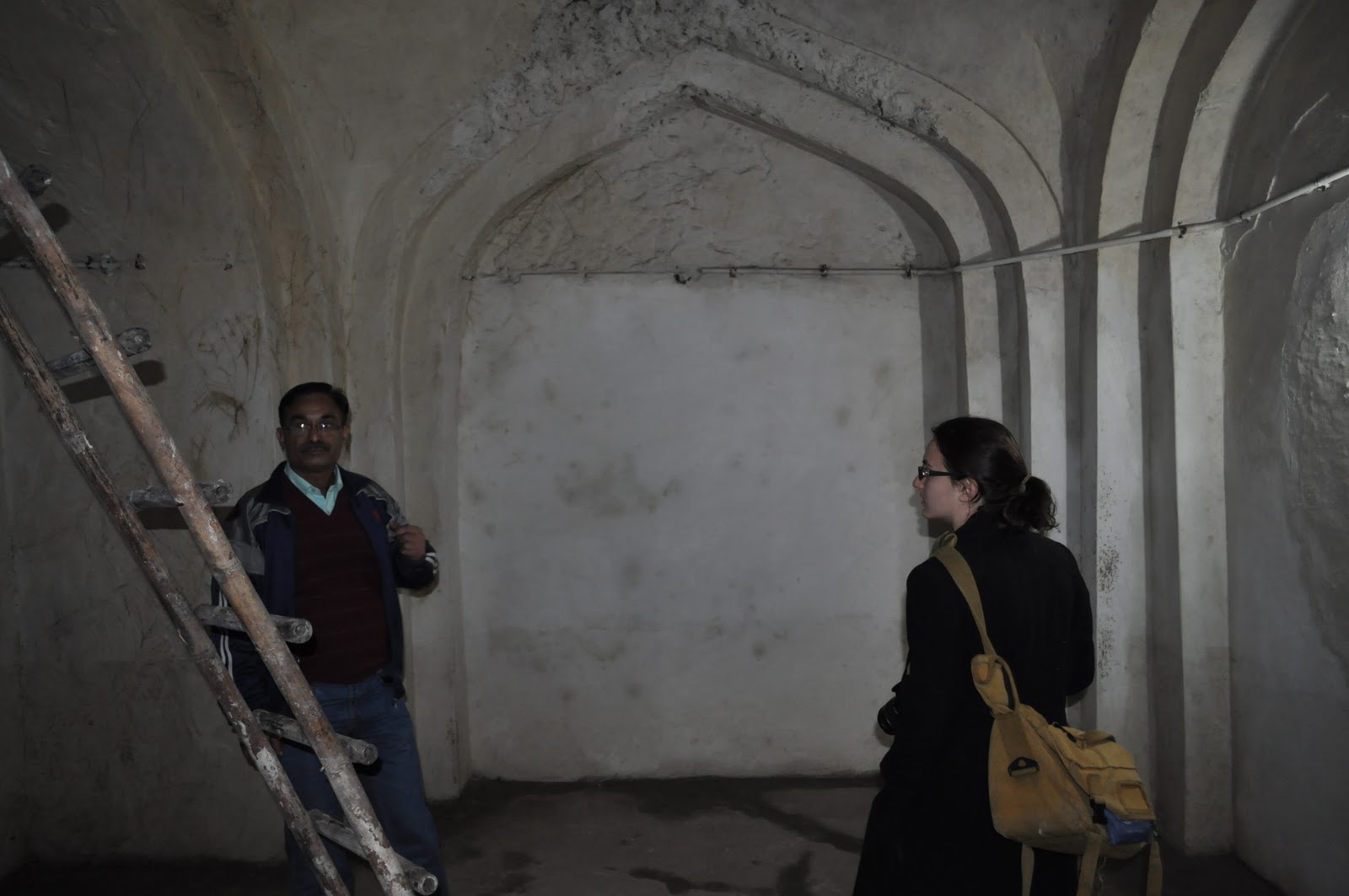
As we climbed down the slightly slippery, poorly lit stairs, three more people had joined us. Using cellphone lights as torches, they guided us down the narrow, winding staircase. Their concern for our safety was touching. After a 180 degree turn on the staircase and few steps, we reached a landing about 10 feet long. At the other end, a few steps led down to yet another landing. This one had three arches, all stuffed up with concrete. It had been whitewashed not too far back in the past. Drops of moisture could be seen on the walls and the underground humidity was clearly noticeable. One of our guides pointed to the three arches. One of them, to our left was originally a passage to the Yamuna, which back in those days flowed where the present day Ring Road is. The one straight in front, so the story goes, led to Agra via the Red Fort. The last one, on the right, led to St. James's, possibly further outside the city walls. Clearly, these were escape routes or secret passages which connected the residences of important people with those of other important people.

One of the men with us also pointed to a clear streak of fainted paint running about two feet above the floor as the flood level this last monsoons. Even today, as the monsoons wreak havoc in the Indian plains and the Yamuna floods, the raised ground water level floods these underground passages, further destabilizing the foundations of Fraser's house. Quoting City of Djinns

'Roots spiralled down from the roof like curvilinear stalactites. It was pitch dark, but as the flashlight passed over the walls you could see that its surface was decorated with beautiful ogee-shaped arched niches. Although it was difficult to see clearly, in some of the arches you could faintly make out traces of Mughal murals, perhaps originally of flowers inside filigree vases.'

The basements have clearly changed beyond recognition since then. The original thin brick walls have been plastered and painted white to keep them from caving in. One of our escorts explained how a few years ago, the walls and the surrounding earth had caved in, creating earthen mounds on both sides and just leaving a few inches wide passage to pass through. There are no roots, no arches on the walls and consequently no remains of the murals now.

The entire basement has however been preserved intact, almost that is. There are still all the rooms, flanked by smaller ones. On the far end is a room, which was apparently used as stables (quite how, I do not know). Then there is another room which was used by the railways as a record keeping room, which roughly translates to shoving piles of unwanted old paper files down into a room till they collect dust. We did not see that room because the underground approach to it had been plugged by concrete but in the words of one of our guides,

'It has a 2 inch thick layer of dust on piles of files, cobwebs run all over the room and its a scene right from a horror movie.'

The rest of it, which we saw was no horror movie at all. It was a large basement, divided into many rooms, large and small, some flanking the others, others with ventilators to keep the building above cool (but now closed). One of the ventilation holes was explained as a dead body disposal hole by one of the men with us. We were skeptical about that. After all, what kind of human, British or Mughal would like to throw dead bodies down a hole into his own basement and then walk down a few hours later to feel the cool of the rooms amidst the stench of the just severed head.

The underground passage tour lasted about half an hour, the distinguishing feature being the pride each of our four escorts took in showing us around. It was almost as if they had family ties to it. It was so moving and touching to be taken personal care of, narrated the legends of the building, shown around the passages and the building. It was also so contradictory. As we walked out into the open, we could not believe we were apprehensive about getting into this building a couple of hours ago. This world was so different from Rail Bhawan (except Ganesh).

Once again, like Nili Chhatri, our visit to a place had been made infinitely more interesting and fun because the people we met were warm, welcoming, human and more people like than anywhere else. What are a few old, dank, damp, cold and undergrounds rooms compared to four smiling and courteous escorts!

And if you have read the last post, it is worth remarking; there was not a trace of trash in the entire building worth photographing, commenting on, writing about or for portraying railways in a negative light! So much for the bureaucracy then.

P.S.: While they are only incidental to the experience, attached below are some photographs of Fraser's bungalow. I am not given to hyperbole, so let me state here for the record: Getting into William Fraser's bungalow counts as the pinnacle of achievement in my Dilli walking career.

Front view of Fraser's bungalow

One of the sentry posts

The dome from the rooftop

The stuffed passages: To Yamuna (L), To Agra via Red Fort (C), To St. James's (R)

One of our escorts. The faint water mark line can be seen.

In the middle of the cool rooms.

The lighted cool rooms.
 

Saturday, 29 January 2011

Getting into The Fraser's

Like I once said earlier on the St. James's post, if you have read City of Djinns, you are in love with William Fraser. If you are not, go get yourself checked, there is something seriously wrong with you. So, then, somewhere in the middle of the book, Dalrymple talks about visiting Fraser's mansion near Kashmiri Gate. One fine morning, bereft of all other inspiration, I picked up the book again and read over the passage about finding the mansion. Book under my arm, page 121 bookmarked for reference, I got off at the Kashmiri Gate Metro Station and about 15 minutes later, walking over a flyover had seen the elusive dome of the erstwhile mansion of William Fraser, the former deputy resident of Delhi.

It was another 20 minutes before I found the road leading to the building and 25 before I reached the gates. The gates were iron grill and a long driveway led to an imposing building with a large lemon coloured dome. Two RPF (Railway Police Force) sentries seated on chairs behind a wooden table in the open just next to the gate immediately gave me an impression I was not welcome. I had a camera around my neck and innocently, I walked in. 'Can I take some photographs?' I asked.

'Who are you?', one of them retorted. I was stumped. I had thought my innocent, sincere looks could pretty much get me anywhere. I gave them a student story and my interest in history and my keen interest in photographing the place and how I had come from far away to just see this building. It did not cut any ice.

'You can't just come here and photograph. Go get a permit.' was the answer.

'Where from?' I asked.

'Patiala House.' he said and then turned his face away. Clearly, we were not talking any more about it.

Dejected, I walked away, my hopes of seeing Fraser's quarters quashed. I guess that should have been the end of it. I had nothing planned for the rest of the day. Patiala House was on the way though I had no clue what it housed. I took an auto and went there. Standing outside the gates, I called a friend who for some vague reason, I remembered had some contact in the railways. A few calls back and forth with him and I did have a contact and some pointers about what I should do though nothing could be done that day.

There was a ray of hope somewhere that I could get in. If I had an inkling about what the next 3 weeks had in store for me, I would probably have not been as hopeful. So, the next day, full of hope, beaming a smile, I reached Rail Bhawan, the mecca of Indian Railways officialdom, who own and run this building. Outside the building stood the image of Bholu, the Guard, the mascot of Indian Railways. It depicts a middle aged man with a pot belly, holding a lantern but with the face of an elephant, the quintessential railways guard who make the railway go around. Whether the similarity of the mascot to Ganesh is intentional or incidental, I cant comment but the way the building seemed to function seemed to be as lazy as Ganesh. Almost as a god sent message, my contact in the building also shared his name with the pot bellied god. I was asked to wait at the statue while someone came down to fetch me. The statement 'Ganesh Sahab ke guest hain!' (He is a Guest of Ganesh Sir) seemed to whisk me past the metal detector despite a ton of metal being detected on me. My hopes soared, I was already half into Fraser's mansion.

The man who had come to fetch me guided me into an elevator filled with middle and not so middle aged men on their way back from lunch. On the 4th floor, we got off the elevator and walked what almost felt like a mile. After the first 2 turns, I had lost all sense of direction. There were wings of the building and each wing had wings of its own. There were long corridors lined with doors, each with a name plate and a room number.  Everyone in the building seemed to be a director or a secretary.

Executive Director, Marketing, Room No 431
Additional Director, Maintenance, Room No 433
Director, Information and Publicity, Room No 434
Senior Director, Administration, Room No 427


Walking past many directors, I reached Room No 438 where I met Ganesh Sir. He was a clean shaven, 30ish, affable man dressed in a full police officer uniform with 3 stars adoring the eppaulette of his shirt. Soft spoken, gentle and courteous, he inquired the reason for my request. Jumping around questions with the usual difficulty I have in making people understand what I have been doing for the past 19 months, I managed to convince. Rather, I should say he was convinced 'There is no point trying to find out the reason for why this guy is wanting to get into a godforsaken building no one wants to see. So, let me cut this short and tell him how to go about it.' Well, it worked for me and I was not complaining.

Together with my benefactor, I once again undertook the pilgrimage to one floor and many corridors down, to the office of the Director, Information and Publicity. A door led to a large room, housing the many people who served the esteemed director. It was a pile of files and people reclining on chairs. In one corner was the sanctum sanctorum of the director herself. I was successively introduced to two people, for there was confusion about who the competent authority really was. The second one, a bespectacled, old South Indian gentleman was berating a man for printing some stationery on the non standard thickness of paper in Hindi with a pronounced South Indian accent. I watched the poor man saying many sorries while not really being so. Finally, after the session had ended, the gentleman turned to us, lowered his spectacles and peered at me over his nose. After appraising me for what seemed like a full minute, 'Yes?'. Ganesh explained the purpose of our visit. There were the usual questions about why etc. He went into a long monologue about why the permission was needed and why I had to explicitly declare that this was for non-commercial purposes. Apparently, a foreigner had once gotten into a railway building and photographed it and posted the photos online. A few days down the line, the Railways Department had used his picture as a background on their website and the photographer objected to it, suing the department for using his copyrighted work. Ever since, Railways decided that they do not only own the building but also the photos taken by tourists visiting them. So, if your purpose was commercial, not only would you have to pay a fee (which is justified), you would never get the permit, or so I was told.

Having convinced him that my purpose was purely personal, we seemed to be on the way to deciding what really was needed when the issue of my blog and site came up. As he heard it, he said 'Why were you hiding it? You are going to use it on a blog, that is commercial use.' All our good work had been undone with the indiscreet mention of the B word and we had gone into the red territory. It took another 15 minutes of cajoling before he agreed a personal blog is not commercial. Then another bombshell dropped. When I revealed that I wanted to get in with some friends, 2 of whom were foreigners, he went red. 'What will they do inside? This is a security issue. Do you realize how much will this complicate everything?' Sheepishly, I agreed that all foreigners are 'security issues' but pleaded that these were not. After all, not all of them are 'security issues'. Reluctantly, after considering the sincerity in my voice, he agreed. Then he said, 'We only issue permits for foreigners.' For a moment, I thought he was joking. He was not. I was supposed to go to another office for getting a permit for myself. If by this point you are confused, don't worry. 3 weeks after I first went there, I am still confused about what happened there.

Before we parted, we agreed that I would send across a sample application letter seeking permission for entry and photography in the building and the gentleman sitting across the desk would vet it before I sent in a signed, printed copy for final verification. Next day, I had sent a draft and within hours received a reply saying it was fine. Promptly, happily and hopefully, I had it signed by my friend and dropped it at Rail Bhawan. The sky was blue, it was sunny outside, I was optimistic. The same day, I also made the pilgrimage to the office of The Chief Public Relations Officer, Northern Railway, which was interestingly situated at the State Entry Road in a run down building. There, I bumped around a couple of desks with my application before I was granted audience and was immediately told to come back the next day so that 'we could discuss the issue'. However, I was told 'we normally do not grant permissions for getting into this building'.

In 2 days, the fortunes of my and my friends had fluctuated a lot. One day, I had thought it was an easy sail for me but not for my foreigner friends. The next, I had flipped my opinion. I was almost ready to start a betting book on the odds of who got the permission first, if at all. Next day, when I went back, it was much better. Apparently my second consecutive showing had melted the heart of the Public Relations Officer and I was told I could get in. I was asked to wait for a few minutes. I waited and was told the printer was broken. So, I decided to leave and come back in 2 days time. By then, they would have fixed the printer. Meanwhile, there was no news from Rail Bhawan. I had set my date of entry as 28th Jan, so I was not really concerned. It was still 10 days away.

Couple of days later, after waiting for the gentleman who had my letter and was having an extended lunch, I got my letter of permission. It almost seemed a little too easy. Rail Bhawan on the other hand was shut like an oyster's trap. I called but was told, 'The file has been put up for consideration'. 2 days later, it had been sent for security clearance but security had not received it. 'The file was lost and could not be traced' was the new status. Ping pong went on and Republic Day arrived. It was 26th, just 2 days to go. I was losing hope. I had lost hope. 27th morning, I called again. It was being located. Half an hour later, I was told it had been found but....and this was a big but(t). Apparently, it had never been sent to security because her highness the Executive Director of Publicity and Information had an objection. My friend, whose application she was pondering over is researching municipal solid waste management as part of a Fulbright Grant. Apparently, the ex director was concerned that she might get into the building, photograph waste and portray railways in a negative light. And I thought we had given the information about her research to establish she was no David Headley, who she had been compared to in my first conversation with the old gentleman sitting outside the director's cabin. So much for credentials. You dont have them, you are doomed. You have them, you are still doomed.

It was mid morning 27th and there was an objection. So, we were asked to send an undertaking by fax, signed and all, saying that we would not do anything to the waste on the premises and ensure we do not portray railways in a negative light, that we would close our eyes (lest they be gouged out) as soon as our eyes rested on a stray packet of gutkha on the pavement. And we did that. Quite why would they be concerned about a building in Kashmiri Gate when the railway stations are squeaky clean (sic) is still beyon dmy limited intellect. The undertaking was faxed, multiple follow up calls followed. The file had moved off its big bad butt. It had gone for security by the evening. This time, it actually reached. 7 in the evening, I got a call from Ganesh telling me security had cleared it. I still hung on to the hope of getting the letter in the morning and postponed my own visit to the afternoon of 28th. I had all but lost hope though. It had taken them 2 weeks to move the file 2 stages. God only knows how many more hiccups before 'the letter' was issued, before the 'fat lady sang'.

28th morning saw me half hopeful, half forlorn. I called up at quarter to 10, was told to call back in half an hour. And then, lightening struck. Before the clock had struck half an hour, I got a call. The letter was ready. 'THE LETTER' was ready. Can you believe that? I still cant. THE LETTER WAS READY. I jumped onto the metro and collected the letter. It was a real letter, real paper and ink, real flesh and blood. Mixed with elation and relief was the apprehension of what twist would the visit actually throw our way. 3 weeks of running around the offices had made me a cynic. Anything was possible. What if they did not recognize these letters there? What if they did not let us in? What if they only let us photograph from the outside?

That however could wait for another hour. For now, we had 2 people with 2 letters to get into Fraser's bungalow. And we were getting in that afternoon, trying to at any rate!

Copy of Letter 1 (personal details removed)
Copy of Letter 2 (personal details removed)


P.S. - Some of the story above is only indicative, partly fictitious and not necessarily true. I disclaim because I was asked to give a declaration that I would not portray Railways in a negative light and I am keeping my promise. :)