Showing posts with label people. Show all posts

Tuesday, 3 January 2012

Sam Miller and The Blue Guide


Sometime last year, I read Sam Miller's Delhi: Adventures in a Megacity and promptly fell in love with it. It was because of sweeping statements like 'Anyone who has not eaten a freshly made dhokla has not truly lived'. I too like to teach people exactly how they are missing life and I absolutely agree, a freshly made dhokla makes it all worth while. But, on a serious note, Sam makes me want to get out and see stuff out of the ordinary. His Delhi is not only the monuments, which in Delhi's cliched context are ordinary, but small everyday pleasures too.

After reading the book, I dropped him an email. Last weekend, Rachel and I met him at his office in Panchsheel Park. There was a lot of conversation about Delhi, its monuments, and books that Sam is working on now. Finally, he gave us a signed copy of Blue Guide: India, officially launching on the 12th January 2012. As it happens, this is the only guide focused solely on India’s monuments and historical sites. It covers all states. From the oldest monuments to the least visited to the well known ones, it covers huge ground. What takes the cake is it took Sam three years to cover them and while I cannot vouch for him having seen every single of these, I am inclined to believe it is as first hand an account as an account ever got. It has detailed site plans for some sites and hundreds and hundreds of sites covered. I can say from my Himachal, Delhi and Chennai experience that it covers as much as there is to cover. If you were waiting for small teasers on the historical places in your state but did not want any spoilers, this book is it. Just the right amount, not more, not less.


Sunday, 4 September 2011

The Posers

At Satpula, near Khirki Masjid, wandering around, I met a bunch of kids. They wanted to be photographed. Look at the below and judge how keen they were! All this was just so I would take more shots. The more I took, the more I refused and the more they resorted to.

That one in the middle was THE HAM!
Getting ready to pose.
Off they go!
Should we say one and a half out of three?
What poses are those?
I know I have not written about the Satpula at all but I promise to soon. Its difficult to write posts when you are a 'normal' working man no longer wandering around Delhi!

Wednesday, 9 February 2011

Hakim Saheb Shafakhana

This will probably be my last post on this blog unless I manage to find the energy to write about many other places I have been to but never got down to writing about. On 14th February, I leave Delhi, travel around South India for 2 weeks, then may go back to the mountains for a month. Thanks to everyone who has been reading this blog and giving their feedback, it has made each entry more than worthwhile and my travels have been enriched by sharing with you.

I had a long standing desire to go to a Unani Hakeem and be told, after reading my pulse, that I was the fittest man ever to have walked the face of the earth. In the absence of any parameters to find the real gold in a pile of crap, we had no option but to try our luck. So, yesterday, 09 Feb 2011, a friend, Johnny and I decided to walk into one of the more prominently visible dawakhanas in Old Delhi. It was near Golcha Cinema in Daryaganj. We had been forewarned to expect some sort of questions about our sexuality etc. As a disconnected observation, I have seen many a medicine practice fall prey to the easy money making route of preying on the psychology of men/women who want an offspring but do not have one. So Unani having gone that way was not surprising. From a time in the 14th century Delhi, when Feroz Shah Tughlaq had erected an entire medresse next to the Hauz Khas tank for students to study this branch of medicine to today, when every street in Old Delhi can boast of a fake pulse doctor, Unani's decline has been slow but sure and steady.

So, as we located the board of the dawakhana, known as Hakim Saheb Shafakhana, the first thing that drew our attention was the text at the bottom. It was a painted metal board with the torso of a middle aged man with a round face. He had headgear with a long protrusion skywards. Intentional or not but the 'protrusion' was eerily similar to a penis. At the bottom, in large bold font, 'SEXOLOGIST'.

A man was standing next to a staircase which led up. As we climbed up the stairs, Johnny and I discussed our strategy. We would go in together and Johnny would start with talking about his throat and knee. Depending on how the conversation went, I would either talk about some genuine issues (which I did not have) or cook up something. On the second floor, after passing a small gallery looking down upon the main street, we entered a room. This was already impressive. There was a reception and a receptionist. The room was not badly furnished either. Having seen 'SEXOLOGIST', I had anticipated a dinghy, ill lit, single room 'facility'. Instead, a well groomed man, presumably a patient was seated on a sofa and the receptionist was behind a table. Another man was standing beside the receptionist. One by one, we spelled out our names. After that I added:

'We want to go in together.'

'Together!!', the standing man asked in hushed tones, almost surprised.

'Yes', I replied.

He tilted his head a little, winked at me, smiled a bit and said 'Ok.'

After waiting for sometime at the sofa, we were sent to an adjoining room. A very small room, small enough to just hold a chair, a table and 2 chairs across the table. When the door was opened, it would almost brush one of the chairs. One by one, we walked in and said Hello. On the other side of the table was seated an old, short, pudgy, triple chinned, paunched, bald man wearing a suit. He had obviously shaved his head but left a tail at the back. I pushed one of the chairs further up to walk behind it to the second one when I was suddenly interrupted:

'No, no, no. Not from the back!! From the front!' Neither of us understood what it meant. As we exchanged puzzled looks, his eye fell on the bag I was trying to place behind one of the chairs.

'What is that?' he asked

'A bag.'

'What is a bag doing here?'

'It is my bag, so I am carrying it.'

'But what is it doing here?'

'It is being placed on the floor.'

'What is in it?'

'A camera.'

'How did the camera come in here?'

Then he called one of his orderlies and said

'How did these kids get the camera in here?'

So, obidiently, we walked out one by one with our bags and cameras and placed them back in reception room. After entering the room again, the 'No, no, no, not from the back' business started again.

This time he also said, 'Men do not sit on the chairs from the back. They come from the front.' After we were seated, he gazed at both of us, asked us our names and then many other questions.

'How old are you?'

'28!? Are you married? Why not? When do you plan to?'

As I answered each question, he had huge, fat notebook open in front of him and he kept noting my response on it.

'Where are you from? You are sure you are from Himachal? Himachal is so big, how can you be from there? Where in Himachal?'

After asking similar questions of Johnny, who had some trouble asnwering some of them, he asked with a smile:

'Are you good friends?' I am not sure if the smile was naughty but I think it was.


'So, how do Shalabh and Johnny know each other?'

Before we could answer, I wanted to get to the point about our visit. Before I could get to the point, he started a monologue. I only remember some part of it, the rest, some very interesting has been forgotten

'By the grace of almighty god', he said, 'we are all here. By his grace, everything works. We eat so many kinds of food. All of it is broken down into 5-6 kinds of things. Then, everything is converted to semen. This is the reality of life. In life, it is very important. People do not want to acknowledge this. But we? We acknowledge this and we also say that if you do not satisfied with what we do to you, you go back and get money. Has any other business given you this expression, this bold expression? I tell you, noone can give this bold expression to you, no where in this city anywhere. It is difficult to get this expression.'

We nodded our heads at the 'bold expression' and he continued.

'You are young people, I can see that. You have lot of energies. You go to college and have many energies and not to know what to do with them. These are not diseases, these are weaknesses. They are only weaknesses and we can help you master these weaknesses. Only we make this bold expression. Now, there are 3 reasons for your weaknesses. Because you have many energies in college, you young boys do 3 things.

1. You do too much hand practice.
2. You do too much sex.
3. You have night ommissions.

Because of this, you lose your energies and then no energies are left. But not worry, you have come to us and we make bold expressions and take care of your weaknesses. You need 5 things

1. Patience
2. Determination
3. I forget the 3rd thing
4. I forget the 4th thing
5. Faith in almighty god'

A lot else went on. Some repetition, some unique phrases. I was wearing an innocent smile on my face, trying to keep from laughing. Johnny was in half a state of confusion and half a state of absolute mirth. Twice, I tried to interrupt and steer the conversation to Unani. Each time, I was told

'Beta, jab bade bolte hain to chhoton ko chup rehna chahiye.' ('Son, when an elder is speaking, the younger people should keep quiet.')

Eventually,we did get down to the question of what was wrong with Johnny and Shalabh.

'I have some pain in the inside of my knees and some pain in the throat.' said Johnny.

He waited with an expectant look in his eyes and kept looking at Johnny. The eyes seemed to say, 'And?'. A little later, getting no response from Johnny, the mouth said, 'What else?'

'Nothing', replied poor Johnny.

'Nothing?' he was surprised.

'Do you have girlfriend?' was the next question.

'Yes.'

'How many?'

'Only one.'

Another pause, another look.

'How much money does she spend on you?' Johnny was stumped. So was I. After waiting a little, he said,

'Quite a lot.'

'And how much do you spend on her?'

'A lot!!'

'Then everything is all right.' Another small pause and 'Is there anything else wrong with you? Any pain anywhere else? Are you sure?'

Then it was my turn.

'I trekked for over a year, walked a lot, over boulders and hard surfaces. Now my knees hurt.' was my complaint.

'You also have knee problem.'

Several questions followed.

'Do you feel pain? Do you hear sounds when you walk? Sounds from the knee? How much does it hurt?'

All responses were diligently noted down, as were Johnny's. After what seemed like an age of noting down our responses, the diagnosis was handed out.

'Mr. Johnny, you have a problem of ENT (Ear, Nose and Throat)'

'Mr. Shalabh, you have a problem of orthopaedics. Mr. Johnny, you too.'

I almost felt like falling at his feet for revealing the secret of the elixir of life to me.

'Not to worry. Sex is not everything. Many problems are there. Not only sex. I can see you have a lot of heat in your eyes and your bodies. You are young people. Do you feel weak?'

We nodded our heads in a No.

'Do you have a good appetite?' Yes.

'This is only first consultation. We charge you Rs. 100 for this. If you want to talk about your problems, you can talk them, all kinds of problems. Not even those of knee or throat. We can do special consultation for you. It will cost Rs. 11000 and we can also do treatment. It will cost Rs. 35000. You have to choose according to your budget. We have treatment from Re.1 to Rs. 500,000. You have to choose according to your budget. So what is your choice?'

'Choices between what? What are the options?' asked confused Johnny.

'You have to choose. Choose according to your budget. We will make you walk, hear sounds in your knees, tell you how to walk, tell you food, listen to your throat.'

'Oh, so you will prescribe a diet?'

'Yes, like honey.' he said in a conspiratorial tone. 'I am not supposed to say this but I told you as an example. We will tel you honey. Money is not the issue. This is by the grace of god almighty. Only you have to do everything. We only do consultation, make you walk, hear sounds. Then you have to do everything and have faith in god almighty. Money is not the issue, we have many by the grace of god almighty. Only you should be happy about it. So, what is your choice?'

'Choices between what? What are the options?'

Repeat the above for sometime. After multiple assertions that a choice could only be made when one had 2 options, he decided to make two signs of blanks in the register in front of each of our names.

'So you have no choices. Thats ok. It is ok. You can get consulatation for Rs. 11,000. Normally it costs Rs. 1,00,000 but for you this is special rate. Money is not the issue, you should be happy. When we do consultation, it will take 4-6 months. How long will you be here, Mr. Johnny?'

'6 months' said Johnny.

'Thats good. Mr. Shalabh, you should show Mr. Johnny the mountains of Himachal. You are good friends.'

Over the next 5 minutes, we made multiple attempts at getting up from our chairs but were bogged down. Eventually, we were handed cards with our names on it, the dates of our visit and an R-5 on it. We are supposed to call back when we have made our choices.

'My assistants dont speak English. Call directly and tell me your choice. By the grace of god almighty.'

Suggestions from those who reach the end of this post are welcome.

The front of the card (in English)

The back of the card (in Hindi)

Saturday, 15 January 2011

Chirag-e-Dilli - Still Illuminating?

A bit of wandering, a few conversations, and I may already be falling in love with Delhi!

Pardon me, that line was written in a high of emotion after my visit to Chirag Dilli. Later, as I visited the much better known Jama Masjid, I have downgraded this statement to something like 'I am still struggling to come to terms with Dilli and I cannot understand and reconcile its contrasts.’ However, let’s not let that take anything away from Chirag Dilli.

First to set the scene, imagine that Saturday night. I was party hopping until 3 am. And, let me confess at the cost of embarrassing myself, this was my first party hop in all of my 28 years. So the night was spent in a swirl of drinks with young, energetic, socialites discussing careers, aspirations, and regrets.

The next morning found me barely a km away from the last party, in the dargah (shrine) of a forgotten Sufi. At Chirag Dilli I met a middle-aged Muslim man from Jaunpur, UP. After an inspiring visit to the dargah of Moin-ud-din-Chishti in Ajmer as a young man, he left his home and his newly wedded wife and has been cleaning up Naseer-ud-din Chirag-e-Dilli's dargah ever since. In 25 years he has earned nothing except what pilgrims care to donate. Once a year he returns home to visit his wife and 3 children, all grown up and working now. But he never really left the dargah behind.

When I asked him if he missed his family he said, “Baba ko chhod nahin sakte, humko inse mohabbat hai.” (I can't leave Baba [Naseer-ud-din], I love him)
and in the same breath added, “Ghar bhi jaate hain, bachche hain, unse bhi mohabbat hai lekin Baba to Baba hain.” (I go home too, I have children and I love them but Baba is Baba.)

As I walked into the dargah, I was greeted by a smile and a general welcome.

“Mehmaan aaye hain,” ( A guest has arrived.)

An authoritative looking man dressed in traditional Muslim attire, who I later realized was the head priest of the shrine said,
“Mehmaan ko dargah aur mazar dikhaiye aur unki khidmat kijiye,” (Show the guest around the shrine and the tomb and take care of him.) The thought ran through my mind, that only two days ago, I was the guest of Hindus and Shiva at the Nili Chhatri temple. Yesterday I was feasting among the young and elite. Today, I was the guest of Muslims and a Sufi mystic who lived hundreds of years ago.

I was offered a chai. The gesture was touching enough in itself but when I realized one of the four people taking care of the dargah had given up his chai for me, I turned to jelly.
Locally known as Jeetu Baba, Mohd Ursan epitomises the contrasts of Delhi. Jeetu Baba lives on the premise of the dargah, under a roof surrounded by just two walls. He does not have a blanket warm enough for the winter but exudes enough warmth to offer his chai to a man almost his son's age. He showed me around the dargah, told me the stories associated with the place, and also pointed out the 700 year old wooden bed which Naseer-ud-din used to sit and pray on. We chatted for a long time. I heard his touching story and wondered at the variety of humanity, how the seemingly least important things can be so important to someone else, how the idea of devoting a life to someone's service can be life itself and how in a few hundred metres, a large metropolis changes colours like a chameleon. Before I left I gifted Jeetu Baba a blanket because I could not see him sleep another night in the freezing cold.

In the romantic utopia I live in, this post should have probably ended here but it can't. If it did, I would be unfair to reality. A few days later, on Muharram, I went back to Chirag Dilli. I had still not gotten over the last experience, was still light headed from it. Jeetu Baba had invited me for the Muharram procession. We were to start at Chirag Dilli and carry the Tazia to Karbala near the Safdarjung Airport, about 12 km and 4 hours away. I was excited, so much that I had excited the interest of a few friends who could not come but were as excited from far away.

When I reached the dargah, the friday namaz was on. Respectfully, I bowed down, one amongst a multitude. The dargah wore a completely different look. The empty courtyard was replaced by a huge congregation dressed in white, bowing down to the power of the almighty, the quiet was replaced by a nasal voice reciting the namaz. The crowd rose to its feet and fell to its knees guided by an unknown force. A few minutes later, after the prayer was over, I started looking for Jeetu Baba. When I could not find him, I looked around for another man I had met on my last visit. Finally, after I managed to locate him, he told me Jeetu Baba had to rush home because of a phone call. He did not know if anything unpleasant was afoot.

His second sentence was, “Did you get the blankets?”

I was astonished, “What blankets?”

“Jeetu Baba said you would bring 5-6 blankets and give them away.”

A lump grew in my throat, I did not know how to react. I just said ”No, I did not say anything like that.”

“Why would I lie?” the man responded in a disappointed and accusing tone.

I was again at a loss. While I was excited about the Muharram procession, I was also feeling a little lonely. In truth I had not wanted to venture here alone. I had to overcome myself and with half a heart was standing in this mosque courtyard hoping to get into the experience. And then this blanket business had struck. The gift I gave Jettu Baba was out of pure compassion and good heart. It was not even supposed to find its way on this blog, and here I was being tormented for more and implicitly accused of going back on a promise I never made. I had no clue what to do. His imploring would not stop. He started asking for money. The magic spell of that past Sunday had been broken. There was a feeling of disconnection, I could no longer associate this courtyard with my last visit. I wandered out hoping to get some respite outside the mosque and waited for the procession to start. The one bridge that had bound me to this place was now on shaky pillars. When I walked out, I half knew the procession was as good as over for me. After waiting for a few minutes, I traced my way back home.

Three weeks later, as I post this, I have still not processed things in full. My two experiences at Chirag Dilli are still separated in time and space. For the fear of some truth being revealed, I do not even want to process them. Half of me wants to go back and meet them again, to understand and talk. The other half is scared on two counts. What if my only discoveries are my lack of understanding and that they used me and abused the saint's name? Neither of these sounds exciting. But is there something else to find? I am undecided. The title was meant to be a statement after my first visit. It has changed into a question after the second.

For more on Chirag-e-Dilli, please read this Wikipedia entry.

Monday, 20 December 2010

Nili Chhatri and the Universality of Humanity

I will start with a confession. Living an unstructured footloose life is not always easy. I’m playing a game against inertia, hoping to beat it as often as possible. Every morning I have to get myself out of bed without knowing what I am going to do; Just searching for an inspiration can often mean a wasted day. This particular morning was mercifully different. The night before, like a thunderbolt, the idea of visiting Nigambodh Ghat had struck me. Nigambodh Ghat is the oldest place in Delhi. Well, at least it’s the location of the oldest surviving legend in the city. In antiquity, it is said, the Hindu god of creation, Brahma suffered from amnesia and forgot all the holy texts. After long penance on the banks of the Jamuna, all the holy texts were thrown out of the river bed by the river goddess. Today, Nigambodh Ghat is a Hindu cremation ground equipped with an electric crematorium which handles about 60 cremations a day. I was disappointed to learn that there is nothing antique about it. And when I walked in with an SLR slung to my neck, I could see I was intruding on nothing special. Taking the cue very early, I left the place. Feeling betrayed by the previous nights thunderbolt, I walked towards Nili Chhatri temple. This is where Yudhishtira is said to have installed a Shivling during the Mahabharata.

When I walked into the nondescript blue concrete temple, there was nothing striking about it. It was very small with two sponsor boards hanging from the roof. It could have been any temple on any street of any town in India. But just as I climbed down the stairs into the compound, an old man was coming out:

Present day Nili Chhatri

‘Are you not from Delhi?' he asked.
'Yes and No. I live in Delhi now but am not from Delhi.' I replied.
'So, what are you doing here? How did you hear about this place?'
'I read about it in a book.' Another man, who was perhaps overhearing our conversation joined in, 'Which book?' 'City of Djinns', I said.

And then came a flood of questions. The pride that their favored temple was finding its way into books and inspiring visits from camera holding-outsiders was plainly visible on their faces. The older man, postponing his departure from the temple, sat down on the steps with only one sock on and started telling me his story. 15 years ago, when he first came to this temple, he did not even have enough money to buy himself a cup of tea. But he started visiting it regularly, and things changed. The old man said Shiva took him under patronage and gifted him a Midas touch. Today, he says, he has everything but he still comes and visits it everyday. 'There is a lot of power in this Shivling, son', he said, 'you make a wish and it will be fulfilled. You have rare luck to have heard of it in a book and come here. Not everyone gets to visit here. Make the most of it.' At moments like these, a non-believer like me starts to understand faith. I may not need it, but if it can turn lives around and give people the heart to bless a stranger they met two minutes ago, may it live long!

The ancient Shivling
The younger man gave me a quick tour of the temple. According to him, 'The shivling is 10000 years old and was installed by Yudhishtir Bhagwan. Ever since, people have come here asking for their wishes to be fulfilled, their agonies to be taken away and the god has never disappointed.' I noticed that the Shivling was draped in leaves and fruit, and milk was being poured on it through a curious looking nozzle. Followers were kneeling down in front of the god to pay their respects.
'Can I click photos?' I asked the man.
'Yes, of course, you are our and the god's guest.'
I was touched. When I left to roam Delhi, I had shelved all expectations of humanity in the mountains. The last thing I expected was to be treated like a prince, taken for a guided tour, imparted with the story of an old man's struggles, and having a god play host to me. Humanity exists everywhere, most of all in a city of 20 million. It’s just covered under the dust of daily existence. The moment you are willing to gently dust the surface, it oozes out lovingly.

The boat going out on the Yamuna
I walked out of the temple with a gleaming smile, reflecting on the satisfaction of meeting good people on the road. I was going to head for Nigambodh Gate, one of the gates of Shahjahanabad. But just across the road was the Jamuna, flowing black and lazy on a winter morning in the haze. I decided to hop over to the dirty banks. So I stood there on plastic and lots of assorted trash, looking over the oily ooze of Jamuna. Far away, in distance, on an island was a huge mass of birds, so many that they painted the island white. Just a few feet away from me, a group of men, sitting on their haunches were getting ready for a game of cards. An old man with missing teeth, grey and disheveled hair, and a vermilion mark on his forehead, walked down to the river bank. One of the card players, a boy, got up and pulled a yellow boat into the water. The old man climbed in and off they went. The young man was singing an old Hindi song, 'Zindagi ke safar mein guzar jaate hain jo mukaam, woh phir nahin aate.' (Milestones once passed in the journey of life never come back.) It was so apt a song for the crematorium nearby, where people come at the last milestone of their life and then have their ashes sprinkled on the holy river. The setting was so calm, the young man’s deep baritone so soothing, the river so serene; for the first time, I felt very comfortable seeing death at such close quarters. After a couple of oar strokes, the boy turned back to the shore and got out of the boat. They had forgotten to take matchsticks. I was anyway wondering about their trip, so I walked over and asked,
'Are you crossing the Jamuna?'
'No, we are just going to feed the birds.', the boy replied.
'Can I join in?'
'Yes, of course.'
Without hesitation I jumped in and we were off. Before the feeding started, incense were lit and set to float on the holy river as an offering. Then the food, salted vermicelli, came out and the birds flocked over. One moment, the boat was a lonely farer on the river. A minute later, hundreds of birds were circling the boat. And we three began to chat.

The hand that feeds the birds
They were a strange pair. An old man, will into the second half of his life, coming to feed birds, supported by a young rebellious teenager who claimed he was, '…a free bird, I am only tied to Jamuna Maiya.’ The old man, he told me, has been coming to feed the migratory birds every single day of the winter for the last 3 years and each of these days, this young boy takes him out to the river. What chemistry binds them, I have no clue. It was not money for sure, something much deeper than that, maybe something which is better left not understood.

The feeding ended too early. Sitting there on the boat over a black, silent, river I could have spent the entire day watching the birds come and feed and watching these two strangers interact with the ease of childhood buddies. Behind it all was the falling ashes of many people who had come to the last milestone of their lives, while I was still living mine. The boat was moored to the bank and I walked out to the road, taking a moment to look back at the scene. There was no Hall of Thousand Columns, no big monuments, no geographic discovery. Yet, I’d had the best day of my Delhi walking life. All I did was meet a few wonderful people and listen to their stories. That is why, they say, it is people who make the world what it is and not the other way around. I have belatedly realized that the living Dilli is part of this circle too.

Friday, 17 December 2010

Guest Post: Profile of a Rag Picker

This is a guest post by Rachel Leven, a Fulbright scholar based out of New Delhi. She is currently researching 'Decentralized Waste Management' and as part of the research, travels around Delhi meeting people, NGOs, professors, and companies working in the sector. For more info check out her blog, www.wastelines.com.

------------------------------------------------------------------------------------------------------------------------
As Shalabh touched on in his last post, Delhi is a place where contradictions are piled on contradictions. The ruins which dot the city are the dull carcasses of a gold glittered age. Once home to emperors, in Delhi they are often just another geographic marker in a slum. I’ll leave it to the reader to imagine whether this is a travesty or the romantic march of time. In any case walking in this city it’s good to remain open to anything the might come up. After visiting the unusually clean and ordered Begumpur Mosque we ran into a living relic overseeing her humble empire of trash just a few blocks away. Since my expertise is waste management we couldn’t pass up the opportunity to share a bag of peanuts, served in a recycled magazine page, with Maya and her band of sweepers.
Maya by her Trash
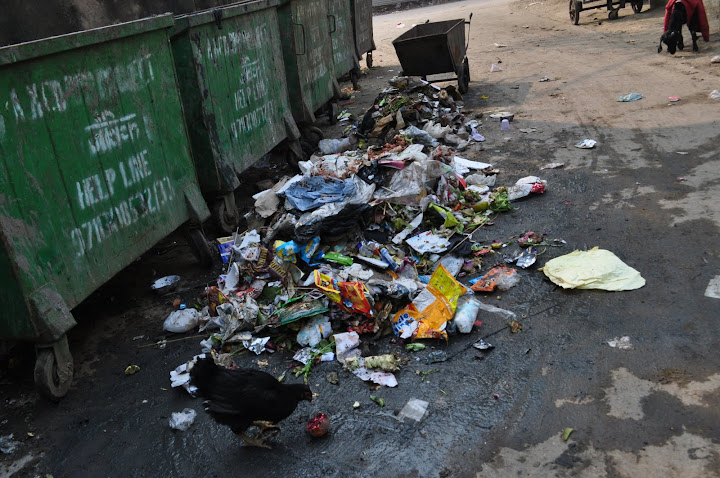
At first glance the street is a dump. Goats dressed in old sweaters and chickens wander between the bins and garbage bags on either side of the road, a dusty side street leading to a simple crematorium. At 2:59 pm the site makes a comedy of Delhi Waste Management’s sign claiming, ‘Zero garbage zone 13 to 15 hrs.’ However on closer inspection Maya runs an ordered and cleanly operation. Segregated bags of waste are piled high and covered with a plastic sheet, waiting for the broker’s next visit. Although the day’s un-segregated waste is picked over by the goats, the garbage they dislodge is sure to be picked up soon. Maya sits close to the ground on a short stool. Surrounding her are five lounging men; aside from her husband, they are all sweepers hired by Delhi Waste Management, a city contracted company, to sweep the neighborhood streets and deliver their bags to the dustbins at this location.

Goats and Chicken feeding on day's trash

About 65 years old, Maya has been watching over this street for 25 years.  She hails from a rural village just a few hours away from New Delhi, in Uttar Pradesh. After marrying she moved to this slum community of Begampur Harijan Basti in Delhi. Before claiming her corner Maya jumped around the city, working mostly with garbage. She eventually struck a deal with the neighborhood surrounding Begampur. In return for keeping the road to the crematorium clean, she would be allowed to use the space to collect and segregate the area’s waste.
Mam Chand (L) with a sweeper (R)
This was no easy job. Maya says that back then the road was a favored spot for street shitting. “The crap was up to here,” says Maya’s husband Mam Chand, waving his hand by his knee. To break the neighborhood of its bad habits Maya took to sleeping on the crematorium road. When residents snuck out to take care of their business in the cover of the night, she chased them down. She remembers, “I carried a big stick with me and would chase them and then ask them to pick up their mess themselves.”  Although she still sleeps in her makeshift home on the road, after more than two decades of guardianship the street is clear and no one is breaking the rules. However, just off the temple’s main drag and outside Maya’s jurisdiction, we found enough fresh material to convince us that her rule is far from obsolete.

Garbage waiting to be segragated
In exchange for her commitment to keeping the road clean Maya is spared hassling by police and no one is allowed to cannibalize her business. Her presence on the block is so strong that when the municipality built cement dust bins to collect the neighborhood’s trash, they built them next to her operation. When the municipality and then the contracted private firm set up their operations they employed the expert, Maya, to ensure that the area around the dustbins remained clean.  This turns out to be a big task as Mam Chand pointed out to us. Although he had cleaned the bins at the other end of the road that morning, there was already a solid mass of garbage collecting around the half empty metal containers. He says the neighbors used to be better about their trash, but with the coming of plastic bags and other disposable packaging people stopped caring about the value of what they dropped, and where they dropped it.


Maya and her husband live a life with one foot in the formal sector, but with little security. According to Maya, Delhi Waste Management currently pays herself and her husband a total wage of 1000 rupees a month. In addition, they make 2000 to 2500 rupees/ month selling plastic bottles and any other valuable waste they can segregate to a broker from the company. The going rate for an unbroken glass bottle is 1 rupee but they don’t often find such valuable material. Their money is made in thin plastic and plastic bottles, 3 rupees/kg and 50 paise respectively. There is also a little money to be made selling the meat of their goats. And there are the chickens, Maya pulled back the door of what I thought was a stack of card board to reveal a comfortably roosting hen.

Although the prices of materials ebb and flow with the market, Maya says that wages have remained about the same for the last 10 years, and in fact were lowered from 1200 when the city contracted out. Maya and her band of sweepers suspect that much more money has been allocated to them but that it is lost in “brokering,” as she diplomatically referred to Delhi’s corruption. All in all it doesn’t add up to much. Mam Chand says, “we make a total of 3 thousand a month, its barely enough to keep two people going on food, milk costs 22rps a liter so that tells you how well off we are.” Although goat’s milk might help Mam Chand save some rupees, there are also medical expenses to consider, like Maya’s appendix operation which cost them 75000 rps. And there is their one child, a widow supporting three children of her own. Their daughter lives in another section of the city but often returns looking for help. “You have to support your kids,” says Maya with a heavy shrug.

Maya sleeps outside to protect the street and her garbage.

Maya and her men are just a small piece of the many layered and complicated system of waste in India. Getting paid a wage brings them closer to a stable way of life, but it’s hardly enough to get by. Any changes to the system, such as the collection of unsegregated waste for waste-to-energy programs, or even a change in habits like better segregation and consumption habits on the part of residents poses a threat to their stability.

Despite this Maya looks over her road with proud resolution. It is her space. One of the young sweepers joked that she was Panchali , meaning a wife to all of them.  Maya was quick to respond, “I live alone here in the night. You come here and I’ll tell you whose wife I am. I have a dagger and I’ll drive it through you.”
With her wit and command it’s not difficult to imagine Maya in another setting, manipulating her self-built corporation from behind an oak desk and far from the grandmother that squatted on the wicker stool before us. But even without the trappings of an empire, she is still the boss and her life will pass on that corner, amongst the trash that is her legacy.