Showing posts with label unknown tombs. Show all posts

Sunday, 18 September 2011

A story from Sultan Garhi

Prince Nasiru'd-Din Mahmud was brash and young. As the eldest son of Iltutmish and the governor of large parts of Eastern India, the prince had unparalleled prestige in the empire and was looked upon as the successor to the throne. This heir apparent slept on a bed laid with rose petals every night. A slave girl was employed just to ensure the petals were laid out well and the prince's bed stayed soft.


One day, tempted by luxury, the slave girl decided to see for herself how the bed felt. After all the prince wouldn’t be back until much later. However, the bed turned out to be so comfortable that the girl slept for over four hours and was only woken when the furious prince dragged her out of bed and ordered her flogged. As she was being flogged, she started laughing hysterically. This irritated the prince even more. He ordered her to be whipped harder. But the more she was punished, the more she laughed. Finally tired of the flogging and stumped the prince put a stop to the punishement and walked up to her.


'What is wrong with you? What is so funny!?'


The girl did not respond and just continued laughing. Multiple entreaties from the prince yielded no response. Finally, after much cajoling, the girl said:


'You will have me killed if I tell you what I think.'


Nasiru'd-Din Mahmud, curious as hell promised her riches and a life long pension if she would just open her mouth. Convinced, the girl replied,


'I was wondering if sleeping on this bed for four hours makes me feel so soft and weak, what must you feel like? You have slept on this bed all your life.'


The prince was flummoxed. This was a man known for his bravery, for having helped conquer parts of East India and was known as Malik-us-Sharq, King of the East. And here, right in front of his eyes, a slave girl, bound and tied was calling him a weakling. Stories say he was a fair minded man. He kept his word of reward to the girl. Before she left she predicted:


'You will never be the king. But you will be venerated as a saint.'


True enough, Nasiru'd-Din died long before his father and never got to be the king, though he was buried in a tomb befitting one. Over eight centuries later, without knowing the weight of the prince’s story locals from Sultanpur and Rangpur pray at the tomb and address him as baba, a title normally reserved for Sufis. Every thursday, the well to do from the villages host a free lunch for the poor. The entire community basks in the light of baba Nasiru'd-Din.


This was my introduction to Sultan Garhi. A middle aged man, lame with a wooden crutch, ostensibly the care taker of the tomb of Nasiru'd-Din Mahmud was flitting around in the dark underground crypt when I entered. Peering through his half closed eyes with a broom in his hand, he egged me to climb down the stairs. I could hardly see anything. A beam of light was entering the crypt from the small, short entrance, lighting the tomb in a surreal light and making it look like something from the distant past. Three graves lay at the bottom, two of them unidentified.


Seeing me stay around for much longer than others, the old man told me this story. There is much around the tomb to see. Its a unique structure, the oldest Muslim tomb in Delhi. You can read more about it here. There are Sanskrit inscriptions around, the oldest well excavated in Delhi, the restorations by the ever present Feroz Shah Tughluq and some Mughal ruins.


For a better version of the story however, you have to make the trip to the tomb and hope to meet the old man. To see the impact of baba Nasiru'd-Din and how a prince-turned-sufi fosters communal unity, find a Thursday afternoon, 12pm to be exact. Enjoy a free meal with the lungars at what is the oldest monument in Delhi.

The mihrab (far) and the octagonal crypt
Chatting in a tomb. Photo Courtesy: Rachel Leven
The divine light. Photo Courtesy: Rachel Leven
At Nasirud'din's grave. Photo Courtesy: Rachel Leven
Photo Courtesy: Rachel Leven
The Thursday feast.

Wednesday, 1 December 2010

Barah Khamba

Location - Hauz Khas/Green Park (click here for the map location)

Co-ordinates - N28 33.177 E77 12.122

Closest Metro Station - Hauz Khas/Green Park (Yellow Line)

Landmark - Aurobindo Place market

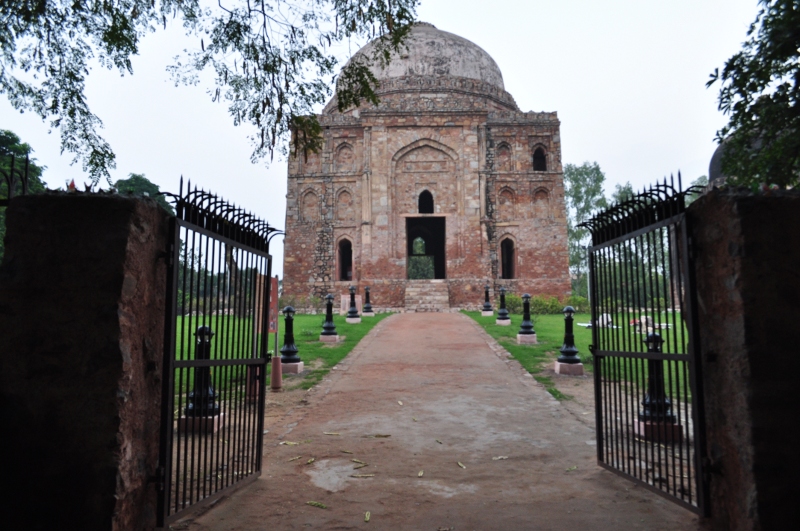
Barah Khamba from the entrance gate.


Barah Khamba literally means 12 pillars. As expected, the square tomb stands on 12 pillars, 4 large ones on the corners and 2 small ones on each of the 4 sides. Each side measures 10.5 metres. The 'Delhi Heritage' board at the entry says 'At one time there were several cenotaphs inside this building,...' All that remains now is some cardboard boxes and clothes drying on a line.

Drying clothes and cardboard boxes have replaced the cenotaphs.
The graves outside the structure, together with a bastion, a dry well and a structure which would have probably held a lamp still survive. The bastion like structure can be seen on the left of the tomb in the first photo. It is said to date back to the Lodhi period. My guess is the square shape on the inside in addition to proximity with other Lodhi period construction leads to this conclusion. I will however need to read more to ascertain this. The square shaped inside has a row of small niches just below the squinch. The north and south walls have arched openings just above the main arched gateways on either side.


The row of niches below the squinch.
Close up of the dome

Like its neighbours, Dadi Poti ka Maqbara Barah Khamba is fortunate enough to be blessed with some artificial lighting, which I later figured was a last ditch ASI effort to beautify the city before the commonwealth games. However, I would rather have spent the money on 'real restoration' of the monument than spend it on lighting a monument which has clothes drying inside it. Anyway, what the lighting does is make all of them look beautiful and surreal after evening, which sort of serves the purpose in a posh neighbourhood, where only 1 in a 1000 walking past will ever think of entering it.

Barah Khamba lighted in the night

Inside the tomb with light streaming in. Photo Courtesy: Rachel Leven

Friday, 26 November 2010

Dadi-Poti ka Maqbara

Location - Hauz Khas/Green Park (Map location here)

Co-ordinates - N28 33.208 E77 12.226


Closest Metro Station - Hauz Khas/Green Park (Yellow Line)

Landmark - Aurobindo Market
The Dadi and Poti tombs from the entry gate

Just as the road turns in towards the Hauz Khas village, rounding the corner around the Aurobindo market, a look to the right transports the scene to the 15th century. On the left of me, across the road is the Aurobindo market. I was in the market at the Midlands book shop, trying to hunt down 'The Hall of a Thousand Columns' by Tim McIntosh Smith. The book traces the 8 year journey of the great Moroccan traveller Ibn Batuta in India and derives its name from a hall in the Tughlaqabad palace which Batuta has eloquently described in his journals. Just as I left the book shop and walked out a little further up towards Hauz Khas village, there was blinding light on the right. It was already dark and I could see 2 monuments bathed in orange light. The domes atop them were lighted puprle. Intrigued, I entered through the black iron gate.

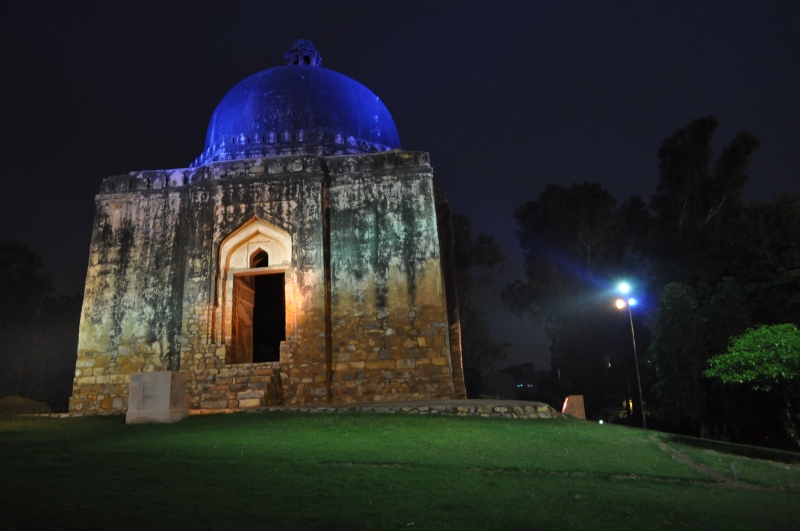
The tombs lighted up in the night

The complex houses 2 tombs, one fairly larger than the other. The larger, Dadi ka Maqbara, dates to the Lodi period while the smaller, Poti ka Maqbara is from the Tughlaq period. The original names of the tombs are not known, nor is anything known about the people buried in. It is said the tombs derived their current names much later and owe this to the disparity in their sizes (Dadi is grandmother and Poti is granddaugther in Hindi).

The tombs from the North

Dadi ka Maqbara - 15.86 metres X 15.86 metres in dimension, dating to Lodhi period, this is the larger of the 2 tombs. The northern and southern walls have arched entrances and 2 levels of 4 arched niches each, giving it a 2 storey appearance from the outside, which is typical of many Lodi period tombs. Inside, the structure is square at the base. As the walls rise, its get octagonal, then hexagonal and finally 32 sided before the sides merge seamlessly to form the round of the dome. There are unidentified graves inside.

From the North East

From the complex's entry gate

Same shot, different time

One of the corners inside the Dadi tomb

Poti ka Maqbara - smaller in size at 11.8 metres X 11.8 metres and with sloping walls typical of the Tughlaq period, this structure is a bit of an enigma. Tombs traditionally have their entrances to the South and as such, the south face gets the maximum artisan attention. However, the south face here is plain. The north face on the other hand is ornately decorated, though the decoration has blackened with time and lack of care. The dome on the top is supplemented by a lantern shaped structure, possibly to hold a lamp. As with the larger monument, there are unidentified graves inside.


The carving (blackened on the top and sides) on the north face of the Poti ka Maqbara

Looking through the South entrance with shadows in the night
The lantern structure on the top of Poti ka Maqbara
Poti ka Maqbara glows in the night
As the evening descends, the lights put up by ASI come on and give them a surreal look. Watching them from the road outside is like looking back in time. From seeing a black Mercedes flit past you to these serene structures which have seen it all for the last 6 centuries. To think that the man whose adventures I was trying to find the book for could have possibly overseen (or atleast seen) the building of these monuments 6 centuries ago!!